
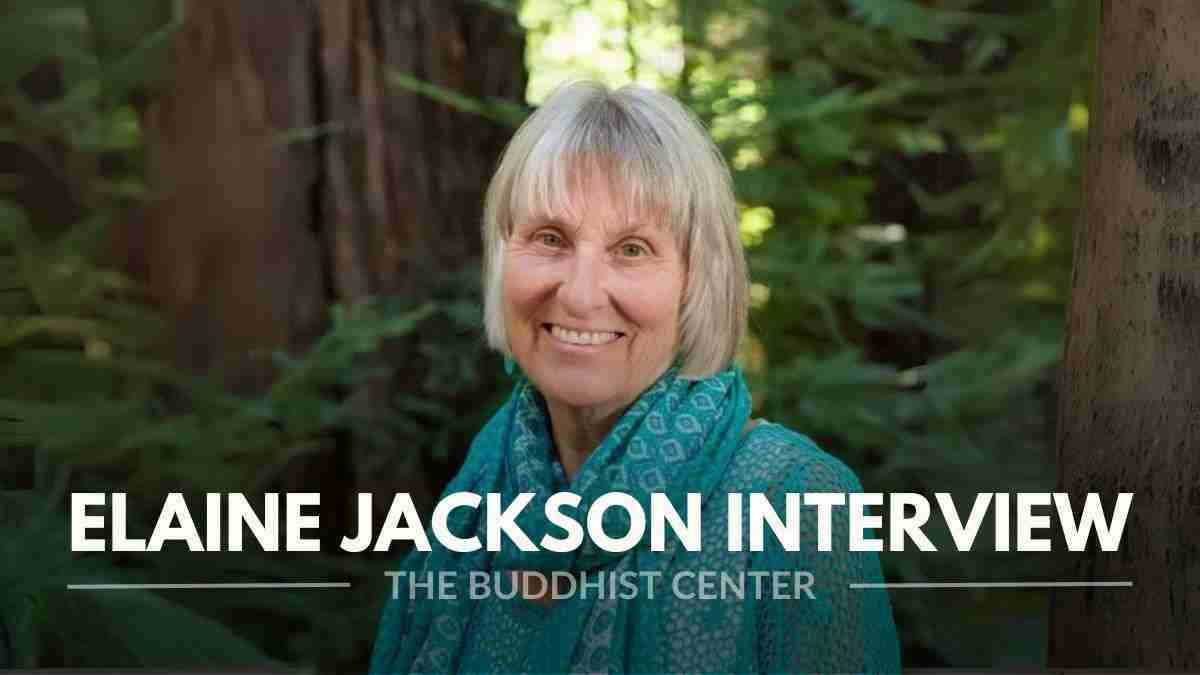
Cultivating Lasting Happiness Course with Elaine Jackson
Sundays Jan 5, 2025 – Jan 26, 2025
In-person & Zoom
10:00am – 11:30am
What is it that we all are pursuing? What is success? How can we all be happy?
Explore these questions with Elaine Jackson from an experiential point of view, using both scientific and Buddhist knowledge of the mind. This course investigates what leads to dissatisfaction and suffering, and how to cultivate true happiness.
Transcript of Interview
Nina Highfill: Hello Elaine, hello everybody.
Elaine Jackson: Hi!
Nina Highfill: Hi, this is Nina Highfill from The Buddhist Center, and I’m here today with Elaine Jackson. She is an old friend and the teacher who is coming to The Buddhist Center very soon to teach a brand-new course. I’m very excited to talk to you about it, Elaine, but I would like to start with a question that will help our listeners to get to know you better.
Could you tell us a little bit about who you are and how you ended up being a Buddhist teacher coming to centers and teaching those courses and leading retreats?
About Elaine Jackson
Elaine Jackson: It is so interesting because it’s a long journey. This started almost 50 years ago, so if we had a couple of days I could tell many stories. But to start with, I met Lama Thubten Yeshe in 1977 at a retreat in Yucca Valley, California.
I came with my husband and our two little children—it was at that retreat that land was donated to have a retreat center in the California mountains. My husband John was a contractor, and he said, Let’s just sell everything and go live in a teepee for a year and build a retreat center. This was in 1977.
Nina Highfill: Two kids living in a teepee!
Elaine Jackson: We were the quintessential hippies at the time. The Vietnam War was finishing, we wanted peace, and felt that this was an opportunity to do something. So we came. We were the first two on the land in our Volkswagen bus and our two children and shortly other people came.
It took maybe two years before we got the permit to build the center. We lived in the teepee and built a small structure beside it for a kitchen and lived there for seven years. My youngest son was actually born in that teepee.
This was a time when so many amazing teachers—the old teachers from Tibet—came to the U.S. to teach. They came to Vajrapani. Many of my friends met the Dharma in Asia. They went to India. They went to Nepal. They took the Kopan course. And Lama Yeshe invited all these teachers to come to Vajrapani to teach us.
I didn’t have to go anywhere. All these amazing teachers came and I could just walk down the hill to Vajrapani. This was an amazing time.
Then in 1989, I started a business in our little town of Boulder Creek. I was a graphic designer and had that business for 20 years. During that time, ongoing, teachers came to Vajrapani, doing retreats now and then.
Then in 1997, the karma for my marriage finished, and I did my first solitary, month-long solitary retreat. That was quite an amazing retreat. It was because Venerable René Fusi said, Elaine, you should do three three-month retreat every year now. I said, Oh yeah, how could I do that? He says, Well, maybe just one month. I thought, Oh, okay, how skillful, maybe I could pull that off. I did manage to do that.
And at the time, shortly thereafter, I was the director of Vajrapani for five years. Then in 2010, I entered into a three-year retreat. This was quite an amazing opportunity. Something people go, What? In my business—because I was selling my business—my clients would say, What are you going to do? But it started with that one-month retreat every year. I did a one-month retreat.
And because I was in a small town and part of a business association, people knew me. They heard that I was going to do a retreat for a month. And afterward, the bank manager said, Are you going to do a retreat again next January? So that started it.
For 20 years, I did a January retreat, a month-long retreat every year until I did the three-year retreat. But I continued that tradition of month-long retreats in January. That three-year retreat I did with my partner, Keith, he was in the main house, and I was in the small house.
For a year, we didn’t speak. When you consider what it’s like to be silent for a year, you begin to see the importance of words or how much we think to say, and we don’t say it. Words just come and they go. We begin to see how thoughts, they come and they go. We had an opportunity to really go deeper these three years.
The second year we would speak, but only when it was necessary. In other words, if you’re going to the garden, bring a shovel or something like that. But we didn’t talk about things. We didn’t go on the internet or have a phone. Vajrapani kindly delivered our food. I would send a message and once a week, the food would roll up the hill. That’s what Rinpoche said years ago at Land of Medicine Buddha. He said, if you’re sincerely practicing Dharma, the food will roll up the hill. And it sure did.
Then after I came out of that retreat, Fabienne Pradelle, Venerable Thubten Droma now, was the director of Vajrapani. She asked me to lead a retreat when coming out of my retreat. In order to do that, I needed to be a registered teacher for Vajrapani, for the FPMT, the Foundation for the Preservation of the Mahayana Tradition. Thubten Norbu Ling and Vajrapani Institute are both affiliated with the FPMT.
I went through the courses that were necessary to get that label. Then I began teaching from time to time. I guess it was for three years I was actually the registered teacher at Vajrapani. That was a label. I’ve been teaching, I love to be able to share what I’ve learned through the power of practicing these ancient teachings.
This course that I’m teaching in January, just kind of blows my mind because for many years Lama Yeshe used to say, Buddhism is not a religion, it’s scientific, dear. Check up. I have always wanted to be able to give these teachings in a way that would be well-held in modern science. But being able to create such a course is a big undertaking.
The two students from Tushita in Spain who created this course under the umbrella of Lama Zopa Rinpoche have created such a beautiful course, with seven modules. This first one is Cultivating Lasting Happiness: Buddhist Mind Science. These seven modules, Buddhist Mind Science is very gradual, it starts very simply.
It’s not about Buddhism. It’s really about understanding the nature of the mind and cultivating happiness. Happiness is in the mind. Suffering is in the mind. How do we cultivate happiness and eliminate suffering? It’s a very beautiful course and it’s very soft. It’s very gentle.
I took this course from Hans and Marina and I’ve taken the second course, now I’m taking the third course. Very gently, it’s moving deeper and deeper into the most profound teachings of the Buddha. I think it’s spectacular, and I look forward to sharing it because it’s so worthwhile.
Lama really wanted what he called universal education. He wanted to bring the Buddha Dharma into Western psychological terms so that people could understand because it’s basically the truth of how your mind works. Now what is psychology? It’s the study of mind and behavior. That’s exactly what Buddhism is, isn’t it?
Then all these various practices to train the mind, to look at the mind, and to train the mind so that it’s not just on the cushion, but it’s through our daily life. What is it that cultivates a warm heart? How do we do that? How do we cultivate that? What is it that brings joy? If we think about it, so much joy comes when we think about being kind to others, and benefiting others.
But there’s this, as Marina said, neediness. We cultivate a neediness which has to do with a mistaken view of reality. This is uncovering that through the power of our own mind, looking, just pausing and looking. That’s what we’ll do!
Elaine Jackson’s Cultivating Lasting Happiness Course
Nina Highfill: So exciting, Elaine. We’re so excited to be able to host this course and to have you also in beautiful Santa Fe. For students who are unsure if the course is for them, is there any particular group of people for whom the course is designed? Or who would you say is the main audience for this course?
Elaine Jackson: I think anyone who wants to be happy.
Nina Highfill: Alright, basically everyone!
Elaine Jackson: Yeah, it’s not about having even an inquiry into anything. It’s just trying to understand why our world appears as it does. How can we create a beautiful world? How can we create a life that is at peace, even in the midst of chaos and confusion and living in a place, in a world where we see so much pain and suffering? How can we be in that and not be overwhelmed by that? To use those as tools to cultivate our loving heart.
It’s really for anyone. It’s also for people who’ve been studying Buddhism for 50 years.
Nina Highfill: But also beginners, right?
Elaine Jackson: Yes, for beginners, very baby beginners. I think for baby beginners and people who’ve been studying for a while, or if your practice is a little bit hot, little bit cold, can’t keep a steady practice. How to develop a steady practice? How to cultivate a practice that is sustainable?
Lama Yeshe used to say, Don’t be a mushroom student, where you get all excited when you go to a course, or you listen to a teaching, and you think, I’m going to do that. I’m going to sit, and I’m going to meditate every day for one hour. We have to be realistic. Small, small, realistic, so that we can grow. Gradually, we grow, moment by moment.
Nina Highfill: Yeah, we’ll come back to that realistic one, because I’m curious about your life a little bit, and how you stayed realistic throughout your life. But just one last question about the course, Elaine, before we move on.
What might people be able to expect to take away from this course? Like, are they going to become happy?
Elaine Jackson: What they might take away is some tools. You put on your tool belt, and then if you use the tools, you will see that they stay sharp, that you can use them to create more stability and equanimity in your life, and to grow your loving compassion. To see, even just to inquire into the nature of reality, the nature of the mind, that automatically puts a pause in how you might be about to react in a way that’s maybe not going to bring you the happy result you want.
I think it’s best to have no expectations, but to just come with a curiosity. We just see, we try. It’s a question of just being open-hearted and open-minded. Come with an open mind and a curiosity, like what might be under the Christmas tree? Curiosity for success in anything we do, right?
Nina Highfill: Curiosity and open-mindedness, automatically have more fun with everything we do.
Elaine Jackson: Yes, to do that, but also, there requires a certain amount of vigilance and dedication. One has to decide. At some point in time, we have to decide what I’ve been doing up until now has not always brought me the result that I seek. How can I change that? Because there’s the key.
Nina Highfill: Well, two last questions, Elaine. One of them is, going back to this practical approach and practicality, you’re a mom of three kids, right?
Elaine Jackson: Yes.
Is Going on Long Retreat Realistic For Everyone?
Nina Highfill: You’ve maintained your practice. You managed to do one long three-year retreat and then retreats every single year, at least a month per year. I think many people who are listening to this think that that’s an impossibility or are wondering at least how you managed to do that because we are all so busy.
For those of us with kids, full-time jobs, and different responsibilities, it’s just so hard to even carve out a few minutes per day, not to mention months of your year or years of your life. How did you do this, Elaine? What advice do you have for everybody who is so busy?
Elaine Jackson: Yes, I think at some point in time, we have to have some faith in our own ability to make a change. We say there are four thoughts that turn the mind to practice. The fact that we have this amazing life that we have. Probably the people who are listening to this have everything they really need: food, clothes, shelter. They have heat in their home. They probably have a car or at least transportation. We have more than we need in this life.
It’s a precious life. We have intelligence. We have our health. But that’s the first thought, to just recognize how precious that what we have here is that I do have an opportunity. I do have that opportunity. I have the freedom to practice. I do have the freedom, even if it’s five minutes. I do have the freedom. I make that choice.
Then the second thing is, Wow, I wonder how long this will last, because we don’t usually think about that. We don’t usually think, Well, I don’t have time this morning, but tomorrow for sure, or maybe this evening. I think tonight after dinner, I’m going to really kind of sit down and practice. No, it’s really about establishing a habit. Same time, same place.
You find a nice corner where you’ve made a beautiful little space. Doesn’t have to be fancy, but you make a place that is your place where you go to be quiet and to inquire into the nature of your mind, to pause and look at what’s important in your life. Those are the two things. If we check up, we do have the possibility to do small, even one day.
I say, Put an x in your calendar one day a month. If somebody says, Oh, come to the party on Saturday. Oh no, no, I have a date with my ex. You do that. You put it down. That’s how you do it. You put it down, one day a month, I’m going to do a day-long retreat. I’m going to do that for myself, my family, my community, and for the world. I’m going to grow my loving kindness, compassion, and my wisdom.
You make that determination because you don’t know how much time you have left. Then those are the first two thoughts that turn the mind to practice. Then the third one is our actions, that all of our actions make a difference. Every single word we say, every single act we do, and every single thought we have, plants a seed that pops up, comes back and says, Oh, look.
This is the law of karma that we have to think about. That’s something to think about because we want to cultivate virtuous acts. We want to cultivate acts that will bring happiness, and we want to eliminate those acts that will produce suffering.
There are practices within Buddhist tradition to do just that, to cultivate virtue and eliminate non-virtue. As a matter of fact, the Vajrasattva practice that we do at Vajrapani at the end of the year is just that, it’s purifying this mind that’s grasping onto some kind of holding that things are truly the way they appear.
The fourth thought is to take a good look at suffering. We don’t really look. When we say the first fact, the first noble fact that Buddha said is, Hey, look, life is suffering. When I first heard that, I said, Oh, come on, that’s a big exaggeration. It’s not that bad. But we have to really look at that.
Even the things that are pleasurable, the things that we look forward to, we have an anticipation, Oh, this is going to be so great. Then it didn’t turn out that way. Or it was lovely, but then there’s some kind of grasping because we want it again, we want it again, and again. Really looking at the various levels of suffering, that’s another aspect to the four things that say, Okay, this is why we should practice.
But really the reason why I practiced that first month was because Venerable René told me I should. I had a teacher that I respected, and I saw his good qualities, and I wanted to also cultivate my own good qualities in a more intense way. Then after that, I said, How do I do that? He said, Tell somebody, tell somebody you’re going to do.
I thought about it and I went into my business and I told my office manager, I said I think I’m going to, I was sure she’d say no. I said, I think I’d like to do a month-long retreat in January. And she said, Okay. She said, If you do this, this, this, and this, I’ll take care of that, that, and that, and it’ll all be fine because January was a slow time. Then it was a matter of ego, wasn’t it? Pride. I said I was going to do it and now I have to do it. Plus she told everybody it’s a small town and she told the bank manager, she’s going to do a month-long retreat.
That’s how it happened. It became an expectation of my friends and my family that every January people that’s what I do. We don’t plan anything in January, which is kind of interesting that I agreed to come to Santa Fe in January, but I will do retreat and I will teach on Saturday.
Nina Highfill: We’ll do our best so you’ll have peace to continue.
Elaine Jackson: No, I’m not worried.
Final Thoughts
Nina Highfill: That’s wonderful, though. I think it would be that much more powerful you teaching that course out of retreat space, so to say mental space. It will be fantastic. I’m sure you motivated many people just by having those four thoughts that turn our minds to practice.
You mentioned that the course is full of tools that will let the students direct their practice and use them in their everyday lives. I was wondering just as a take-home message for those waiting, if there is one little tool you could share that people could use maybe on a daily basis or whenever they can, that could help them prepare for the course?
Elaine Jackson: Oh, that’s very interesting. Maybe to simply, once a day, take a pause. Particularly if you find yourself rushing or irritated as you stand in line at the grocery store, just take a pause and a few breaths. Watch your breath and see what’s arising in the mind doesn’t have any solidity, that it doesn’t need to allow you to continue down the road to suffering. That irritation that we call the river of misery.
For many years when I was young, they said, Oh, well, before when, if you have an angry thought, then count to 10. Did you ever have that when you were a kid?
Nina Highfill: Yeah, we do, it’s the same way.
Elaine Jackson: It’s just pausing for a moment and seeing how it is that we don’t need to be like a bull with a ring in his nose, led around by every thought that arises in the mind. Just begin to be a little bit mindful of what’s coming up in the mind and pause. Maybe take three breaths. Just take a pause and try to smell the roses.
Try to take in the good. When you go somewhere, look at something beautiful, the orchid on the table. Or even when it rains, the dew drops, the raindrops on the leaves, whatever it is, trying to, to look at the good. This is really helpful to the mind.
Nina Highfill: Thank you for this advice, especially during the holidays, our minds tend to become busy. There are many to-do lists, gifts to buy, meetings to go to, and so on. I think it’s wonderful advice for that time, for everybody to try to remember to smell the roses sometimes because I think they’re around. We just don’t always notice them when we run too fast.
Elaine Jackson: Yes, it is true, because it can immediately change your mind. If we can just pause enough to, as Lama used to say, glue on the opposite. If an unhappy thought or an irritating thought, some mental affliction arises, if you can glue on the opposite. The person taking forever in line, to think, it’s possible that it’s really hard for them. Then your compassion rises. To glue on the opposite, to try to find the good.
Nina Highfill: Yes. Well, thank you so much, Elaine. The course that Elaine Jackson will be teaching, the Buddhist Mind Science course, and its first module, Cultivating Lasting Happiness is starting in January. That will go on for four Sundays of January at 10 am (MT), and it will be in person in The Buddhist Center in Santa Fe, and also online.
And don’t forget to take a pause and smell the roses. Thank you so much, Elaine. I wish you and everybody listening happy, peaceful, beautiful, good holiday break. I hope you will find some time for yourself, and we are looking forward to welcoming you in Santa Fe, Elaine.
Elaine Jackson: Thank you, I look forward to seeing you. Take good care.
Nina Highfill: Thank you, you too.
Interview conducted by Nina Highfill
Nice interview, Elaine-la! Thanks to Elaine and Nina.
Thank you so much, Lynne! I’m really glad you enjoyed the interview. Nina was a wonderful host, and it was such a pleasure to have that conversation.”
ThAnk you both. From 10 to what time?
This web page first says no information available.
I’m using .
.
My phone.
Hi Mary, thank you for your interest! I apologize for any confusion with the webpage display on mobile. The event runs from 10 AM to 11:30 Sundays Jan 5, 2025 – Jan 26, 2025 In-person & Zoom. I apologize and so sorry for the late response.
Elaine – I’m loving your teachings and guided meditations. I’ve been missing this. Thank you , thank you!!
I wondered if you could include the wonderful bookends or embracing palms of motivation and dedication – if not integrated into the teaches then the lovely prayers that exist
Hi Alex, thank you for your wonderful feedback! I’m glad that you’re finding value in the guided meditations. Could you elaborate on what you mean by the wonderful bookends or embracing palms of motivation and dedication? We’d love to better understand your suggestion so we can consider incorporating these elements in future sessions.” You can email me at benjamin.bowles1@gmail.com Thank you.