

How has The Buddhist Center impacted your life?
The Buddhist Center is a source of inspiration because you see so many other people who are engaged in the same goals as you and everyone is helping each other along. There have been times in my life when I’ve lived close to a Dharma center and other times when I haven’t. When I haven’t, it’s much harder to keep my Dharma practice going.
It’s also much easier to have wholesome friends. Especially as a beginner, you’re pulled in many different directions. Your friends may not have the same goals, ideas, or values. It can be difficult if all friends are going out late at night drinking. Drinking by itself is okay, that’s not a big deal, but when it’s to excess, you lose control, and then you engage in negative behavior. Those kinds of things are much easier for a beginner if you’re near a Dharma center.
These Dharma centers have shaped who I am. Plus, I have met some of my close-to-my-heart teachers at those Dharma centers because they’ve either been traveling through or were teaching there, and I got to know them better. I really understood how special they are and how special the teachings are. In all of those ways, the Dharma center is very important, for me at least.
I see the Dharma center as a continuation of Rinpoche’s vision, especially now that he is gone. For each of us who are his students, and especially those of us who have been his students for a long time, it’s our responsibility to help with the Dharma center as much as we can, in the best way we can.
I see the Dharma center as a continuation of Rinpoche’s vision, especially now that he is gone.
What is your journey with Buddhism?

I grew up and lived in India until I was 15, my parents were Hindus, and my mother was a very devote Hindu. They had their gurus, and we went to the ashram every month. I even had a special mantra that some guru whispered in my ear that I used to do every day until I was 14, but then I came here and forgot it.
I was a cultural Hindu at best, and it never particularly resonated with me, that’s not to say—there are lots of great things about Hinduism and there are amazing teachings in it, but I was never really exposed to them. The idea of praying to a creator or god didn’t work for me either.
The idea of praying to a creator or god didn’t work for me either.
Anyway, in my 20s I was searching because I was going through a difficult period—as most young people do—with relationships, that was the start of it. I started searching, and I guess because I grew up Hindu, the Tibetan Buddhist approach appealed to me because of all the iconography, deities, and statues. But for some people, like my wife when she first got involved, it was just too overwhelming, she grew up in the Episcopal church but still, episcopal’s do have some iconography and stuff but still, this is just over the top in the gompa.
But it appealed to me. So I started in the mid-90s, in a different tradition, in a Nyingma tradition, another Tibetan Buddhist school, and I met some of Rinpoche’s students in the late 90s and I realized what a special teacher he was. He had a center of gravity that pulled me in, and I started studying and practicing seriously in the late 90s with Rinpoche, many retreats, and teachings.
What relationship problems led to you discovering Buddhism?

It’s been so long, it’s hard to remember. But there was the break-up with my girlfriend that was a cause of distress. But the other thing I realized was there was a lot of dysfunction in my family, with my parents and I, there was just a lot of dysfunction. I was trying to process it and I realized that there had to be a better way than just muddling along.
I was going to therapy—this was in the 90s when people still thought that therapy was kind of strange, I was doing the work needed, but it still didn’t quite work for me that well. It made rational sense, I was able to talk it out, but the patterns never changed. You just talk.
When you’re going through therapy you’re talking about these things, it’s all on a rational basis, but when things happen you don’t think about them rationally, you react instinctively, so it wasn’t really making any change for me. I thought, There must be a better way for me to do this. I started reading Sogyal Rinpoche, The Tibetan Book of Living and Dying, which is an amazing book. Everyone who is getting started should take a gander at that book. That’s how I got started.
The Buddhist approach really made a lot of sense. The idea that 1, how one is, is basically a product of one’s own karma/actions, not like the world is out to get me, or that it’s all my parent’s fault. But really it’s up to me, especially as an adult. When you’re young you can blame your parents because you don’t have any agency, but once you’re an adult you can no longer blame your parents, they don’t have control over you anymore.
Once you’re an adult you can no longer blame your parents, they don’t have control over you anymore.
I realized that I have the agency and I’m the cause of all these problems that I’m having and I’m also the solution. That’s the good and bad news. And because things are never permanent, that’s a good thing because it doesn’t mean I have to live like this forever, I can make the change. So that’s how I got into it.
As I learned more about it, it just made more sense and I saw the changes happening within me over time, and that gave me a sense of confidence that I was on the right path. Because if you don’t see change maybe it’s not the right path. Buddhism isn’t the right path for everyone, and that’s fine. But if one sees change, then you know that that’s the right path. Unless there’s a better path, which is fine too. Maybe there’s something faster, maybe magic mushrooms will do it. I don’t know, but if it works, great!
Buddhism isn’t the right path for everyone, and that’s fine.
How has meditation impacted your life?

Meditation has totally changed my life, I used to be a very impatient, self-centered, self-absorbed, jealous person. Everyone has these qualities to some degree or other. Then with meditation, it’s really interesting because I have become much more patient now, especially with family relationships. The people you are closest to are the ones you hurt the most, that’s just the way it is.
The people you are closest to are the ones you hurt the most, that’s just the way it is.
I’m much more patient, I don’t rise to anger as quickly, I’m able to have more humor in my life, and I can laugh about things more and not take them as seriously. Not every little thing that is annoying makes me annoyed. I am able to see the forest from the trees, to see the bigger picture.
I am able to see the forest from the trees.
Especially with Rinpoche’s guidance to be able to be outside of oneself, not everything is about me. It’s no longer all about me. There are so many teachings on bodhicitta, for example, which brings you outside of yourself. So when you get a gut punch or you’re in a depressive mood, it’s much easier to rise out of it, you don’t go into that rabbit hole.
Rinpoche had a great book called Letter to a Friend, which are letters his students had written to him about various problems in their lives and what his answer was. Many asked about depression—which I struggled with as well—and he said to meditate on compassion and to think about others. And I’m not talking about clinical depression, this is not a solution for everyone.
But certain types of depressive moods are a self-absorbed mood, you are wrapped tight around yourself, and you can’t see anything outside of yourself. If you are able to meditate on the bodhicatta, you can feel a connection with other people, and that brings you out of that mood, to be able to relate to others again.
There are antidotes that I learned about doing these different meditations. For example, I learned how to use impermanence for annoyance, like this enemy could be my friend soon. Or I remember my wife shouting down the stairs at me because she was upset with me and my anger arose and at that moment I felt the “I” arise, the ego, that was going to come back with a zinger. You look at it and think, Wow, there is that “I” again, and because you have done these meditations you know what the “I” looks like and what emptiness of the “I” means.
You can look at it and say, Wow, there is that thing, it feels so solid, but I know that it’s totally ephemeral, it’s an illusion. I don’t need to go back with a zinger because it’s not real. It’s a thing manufactured by my mind. Those kinds of things really make a real difference in one’s life. You’re able to be more forgiving, more patient, less prone to anger, more compassionate, and more compassionate towards oneself.
All young people are hard on themselves to some degree. But with these meditations, one learns to be compassionate with oneself. You realize you are not that different from other people, what you see in others, is how you are. That also makes you more humble too, it keeps you grounded. It’s not like I’m some big deal because I have all this money or this promotion or this beautiful wife or whatever it is, there are all these reasons you put yourself above others.
All young people are hard on themselves to some degree.
Advice for beginners to meditation?
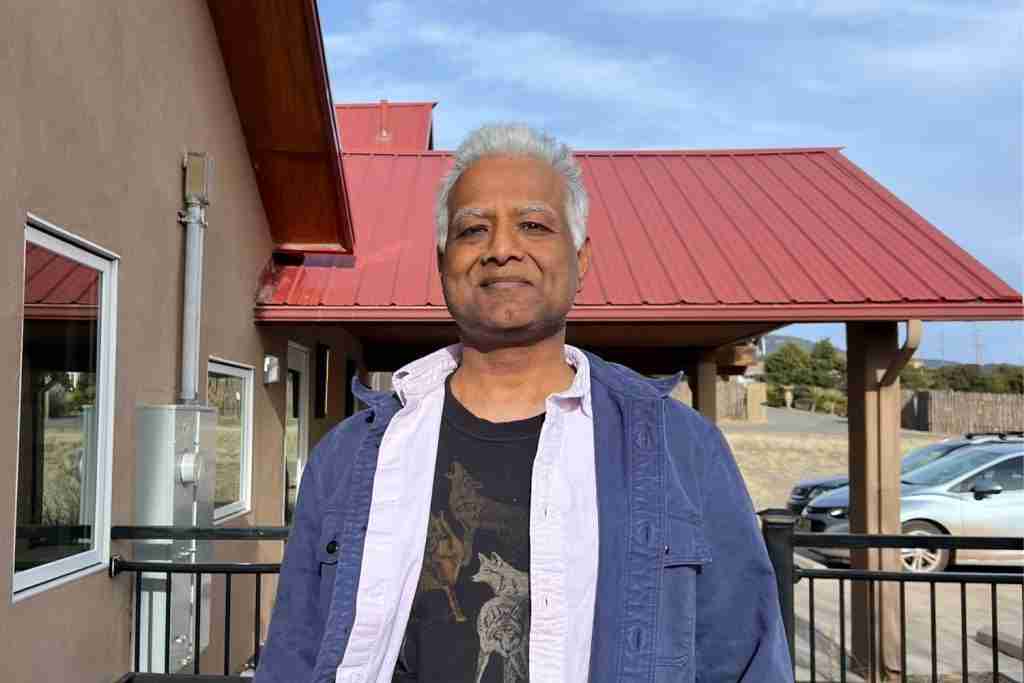
It is a constant struggle, it’s not just beginners, I struggle with it. Until you get to a certain point, a certain level of realization, you are always swimming against the tide. We have so many distractions and things pulling us in different directions, so it is totally normal for it to be hard. What is good for beginners is to not put pressure on oneself, that is the biggest thing.
What is good for beginners is to not put pressure on oneself, that is the biggest thing.
Do whatever is needed so you enjoy yourself, there’s no pressure. It’s only you and your mind. It’s not like anybody knows what going on in there. Nobody can judge you, nobody can see inside, you have total freedom to do what you want and that is pretty cool. If at the beginning, 5 minutes is all you can do, then do 5 minutes. That’s all it takes.
For beginners, what the teachings say, is to make a pleasant spot for meditation, whatever that happens to be. If there’s a view out of a nice window, or if you meditate in front of flowers on a table, or an altar with pictures of whatever inspires you, doesn’t have to be Buddhist, it could be the pope or flowers, whatever makes one feel good. Make a space that feels good, so you want to be there.
Then, pick the same time and same place, and pick a certain time of day. The easiest is in the morning, but it doesn’t work for everyone, so whatever works. You pick that spot, you pick the same time, then you sit down and just meditate for five minutes. If 5 minutes is too long, you do three minutes. The teachings say that in the beginning, you do short and many, each session can be 1 or 3 minutes, you have total freedom, do whatever is natural and comfortable. Then take a break, 30 seconds, 1 minute, however long, but not long enough to get distracted, still staying in the zone but relaxing the mind. Then do another 1–3 minutes, then take another break, and then do as many as you like.
Then over time, as you get better at it, and build the habit, you make them longer and with fewer breaks. That’s the way to do it, to really make progress. Some days you will have a fabulous meditation, your mind will be totally focused, and time will feel like it’s flying and it’s effortless. Then the next day can feel like crap, the mind is everywhere, with no focus, it’s a struggle, so that’s when people get discouraged. But it’s important to remember you can never recreate that feeling of a good day, so you have to just let go of that expectation.
It’s not a straight line of progression, it zigzags and goes up and down. But hopefully, over time, the trend is going up. So just take it as easy as possible, and do it consistently for 6 weeks because it takes 6 weeks to make a habit, that’s what modern psychology says at least. Make an effort to do it for 6 weeks, even if you don’t have time to do 5 minutes, just do 1 minute. It is the consistency that matters, it’s not how much time one spends, it is that one made the effort that day. That is what makes a difference.
I know this for myself in many different disciplines, I play the violin as well, the hardest part is getting the violin out and starting to play, the rest is easy. But if you’re playing 10 minutes a day, at least you have consistency. Consistency is most important for beginners. Then when you are more advanced you can be more flexible. You do different things on different days, and you know that even if you haven’t spent as much effort that day, you still have this reservoir that you built up, so you can count on that when you really don’t have the time.
Consistency is most important for beginners.
There are some days that I can’t get myself to sit down for a meditation, but I don’t beat myself over it because I’m at a point where I have the luxury to be able to do that because I spent the effort in the beginning. It’s doable for anybody, if I can do it, anyone can do it, it’s not like I have some great gift. That’s the whole thing with the Buddhist approach, anyone who has interest and is willing to put in the work 5–10 minutes a day, can make incredible progress, it does not take that much effort.

That is the wonderful thing about Buddhism, if this approach doesn’t work, there are other approaches, they say the Buddha gave 84,000 baskets of teachings for 84,000 types of minds because no size fits all. Some find Buddhism so confusing because there are so many different things, it’s like going to the supermarket for the right kind of toothpaste and there’s a whole aisle of toothpaste, which do you choose? It’s difficult to choose, so you need a guide or teacher to help you choose the right toothpaste.
But maybe you try the first toothpaste, and it’s awful and doesn’t work. But there are so many other toothpastes, so you just try another one, you tell the guide, Okay this isn’t working, what else can I try? That’s the beauty of it, there are so many different approaches, so there is something that works for everyone. You just have to make an effort. That is why the spiritual guide is so important.
That’s the beauty of it, there are so many different approaches, so there is something that works for everyone.
For me, for example, breathing meditation is so difficult. I can’t do a breathing meditation, I’ve been trying to do a breathing meditation for 30 years now. After about 2 minutes I’m not on the breath, I’m somewhere else. I know for certain that it’s not an approach that works for me, but that’s okay. I can meditate on a mental image or a sound or holy object or my mind itself, there are so many others. I don’t need the breath. That is where the power of Buddhism comes.
It’s not just mindfulness. In the West, Buddhism is equated with mindfulness; mindfulness is absolutely important, there is no Buddhism without mindfulness because you need to be mindful of one’s actions, to have ethical behavior which is a cornerstone for Buddhism. You need mindfulness to know what you’re doing with your body, speech, and mind, but it isn’t everything.
You need mindfulness to know what you’re doing with your body, speech, and mind, but it isn’t everything.
There are many higher-level goals in Buddhism; the ultimate goal is to benefit others, to perfect oneself to the point where one has all the skillful means to best benefit everyone in the universe. That is the ultimate goal of Mahayana Buddhism, which is incredible, and almost seems unachievable. Mindfulness is the beginning, it’s a tiny part, so if people were really practicing bodhicitta, compassion meditation, and all of these other things, it would be amazing what they would be able to do, not just leading a stress-free life, which is also important.
The final piece of advice is to stop meditating before you get tired, stop at a high point. Don’t wait for the downhill, it’s like the football player who leaves on a high note instead of waiting for everyone to want him out. If you stop on a high note you leave with positive energy and want to do it again. Don’t just keep doing it until it’s all a struggle.
Interview conducted by Isabela Acebal
Very interesting interview, Shankha. Thank you for sharing.
Happy that you found Shankha’s interview very interesting.
Thank you for sharing this. I like the toothpaste analogy!
Shankar, I have long wondered about your Buddhist path. Thanks for sharing! You are an inspiration.
So glad you were inspired