

What is the November Course?
The November Meditation Course was established in 1971 by Lama Thubten Yeshe and Lama Thubten Zopa Rinpoche, the founders of Kopan Monastery and the Foundation for the Preservation of Mahayana Tradition. This course has earned world-wide recognition and is attended by hundreds of people each year.
The November Course follows the Tibetan Gelug Tradition of Buddhism, and is based on Lama Tsongkhapa’s Graduated Path to Enlightenment – the Lam Rim. Through Buddhist teachings, meditations, and discussion groups, students will learn to see themselves and reality in a new way.
Gen Don Handrick

I was the course leader in 2015, so I can only speak about my experience. What’s most amazing about the Kopan November Course is the opportunity to be with people from all over the world; for a month you are with people from all different corners of the world and a variety of ages. You get this really wide range of people, some of them new to Buddhism, some who have been practicing for some time. The course is designed to create something special for whoever you are, whatever level of study you’ve done before.
The course is designed to create something special for whoever you are.
It is also intensive for some people. Every year some people disappear in the first few days because it isn’t exactly what they were looking for. It entails getting up a little early for practice and then meditation before breakfast. Then there will usually be a morning teaching for around 2-3 hours, a lunch break, and a discussion in the afternoon.
We give discussion questions, there’s usually a facilitator that helps coordinate each group and they have an opportunity to discuss the teachings that they’ve received and learn from each other. That’s where a lot of the bonds are formed, people come away from the November Course feeling very close, especially to the people in their study group.
Then there is usually a tea break, then another teaching before dinner, and after dinner there is an evening practice session. It’s a fair amount of meditation practice, but not as much as some people would think it would be. They hear the November Course and think it’s going to be mainly meditation and a mostly quiet retreat. However, this is typical Tibetan Buddhism, so there’s a lot more talking, interactions, and teachings happenings.
For the retreat I led, Lama Zopa Rinpoche showed up for the middle two weeks, and everyone loved having Rinpoche there, his energy was pretty incredible. It’s good to have some teachers who are deeper in the tradition, like one of the geshes or monks. That part of the retreat is more interesting in some ways for students because they are exposed to a deeper level of teacher. I always think of myself as more of an instructor rather than a real teacher, just giving Dharma instruction in terms of the Buddha’s teachings.
A couple of things they do that is interesting is they have a pilgrimage day in Kathmandu Valley. There are many sites to see, you usually go down to the Boudha Stupa and do circumambulations there; then go to Swayambhunath, which is often called the Monkey Temple, where the monkeys are hanging out and getting food from the pilgrims who go there. That’s a really nice day for people because they get out of the monastery. It’s an opportunity to see some of these holy sites and to spend time in Kathmandu.
We also introduce students to the idea of taking the 8 Mahayana Precepts. This is a very powerful practice for accumulating merit and purifying, you essentially take vows for 24 hours. We usually take the vows every morning for the last 2 weeks, and you hold the vows as purely as you can. This includes not eating after midday. You generally have a very small breakfast and then a lunch, and then you don’t eat the rest of the day.

You also refrain from some of the standard actions that are part of the Lay vows like not killing, stealing, lying, and so on. They are a really powerful way to engage in some merit-making and purification while you are there. When Lama Zopa Rinpoche was doing the retreats, he would give the oral transmission of the precepts formally on the first day, then you would take them on your own after that.
It is essentially a Lam Rim retreat. You go through a brief review of the Lam Rim in the first few days. The Lam Rim, the stages of the path, goes through the Buddha’s teachings in a very sequential way, first to have the motivation of getting a good rebirth, secondly gaining liberation, and then the motivation of attaining enlightenment, Buddhahood. After that, we go into each topic much more in-depth. Students have the opportunity to see the richness of the Buddha’s teachings and everything that is entailed in Tibetan Buddhism, specifically the Gelug tradition has structured studying and practicing Buddhism.
It is essentially a Lam Rim retreat.
The teachings can be challenging for many people because the audience is diverse in their understanding or lack of understanding of Buddhism, some people aren’t quite ready to sign up for that level of study or practice. Again, maybe they didn’t read the fine print and thought it was a mindfulness retreat. And they end up coming to something that is much more about study and investigating teachings, and that can be a little challenging for people.
But certainly, those who have done a Lam Rim retreat before, always find it useful to go through it again, because every teacher will teach it slightly differently, emphasizing different points. Lama Zopa Rinpoche used to say that the Lam Rim was the real meditation and this is what we need to realize and actualize in our minds. He said going to Lam Rim retreats, even many times, is extremely useful. People who have studied Lam Rim and say the know the Lam Rim, will still gain something in a retreat like this where you go through each of the topics in a very condensed format.
People who have studied Lam Rim and say the know the Lam Rim, will still gain something in a retreat like this.
What should you know going into the November Course?

People should know it’s a bit of a challenging schedule. You don’t have to attend everything, but you are encouraged to do so because that will make the retreat. Certainly, the morning practice was a bit more optional, as was the evening, but everything in between, especially the teachings and meditations, are strongly encouraged. As long as you are aware of what the schedule is and are prepared for it to be a fair amount of teachings, then you’d be ready for that type of retreat.
People should know it’s a bit of a challenging schedule.
Certainly, people can investigate the Lam Rim ahead of time, there are a number of short books, a couple by His Holiness the Dalai Lama, that really go through the main topics of the lamrim. The one I often recommend to people is called, Becoming Enlightened, it’s a book His Holiness wrote with Jeffrey Hopkins, to go through the Lam Rim in a very sequential way. It’s a wonderful overview and gives people a taste of what they’re heading into for the retreat.
You don’t have to sign up for everything in the Lam Rim, like rebirth and karma, which are challenging concepts for many Western students. The gift of this retreat is the chance to discuss with others and explore your hesitations about some of the teachings, and to see how others have worked through their questions and doubts.
Much of what we do in the West is receive teachings but we don’t have the opportunity to process them with others. In the Tibetan Tradition, especially the Gulug tradition, in the monasteries the monks and nuns all do debate, they’re out in the debate yards working with their material. I was told by one of the geshes, Tenzin Tenphel, that in the monasteries you gain about 25% of your knowledge from the teachings of the abbot or instructors, 25% from your own self-study and working with the material outside of class, and 50% from debate.
They spend a lot of their time in the monasteries in debate. It is important to work with debate, to gain some insight from discussing with others what you heard or if you have questions, and have people reflect on that. The discussion groups are a wonderful opportunity for that. In our centers I feel we don’t do enough to promote that. I don’t think we know if we’ve digested something until we’ve expressed it to others. Once we’ve said it to others we have a better idea of whether we hit the mark or if we are not complete in our understanding, what things need to be changed or reviewed.
They also do a translation into two or more languages, when I was there they did French and Spanish. They do simultaneous translation then they break into discussion groups for those languages, so they can discuss in their language. It’s a chance for people to express their understanding and investigate topics in their own language, rather than always being forced to do everything in English, which sometimes happens in these sorts of gatherings.

The meditation isn’t terribly long, someone very experienced with meditation might find it shorter than what they might like to have in a retreat. Nonetheless, it’s to give everyone the opportunity to sample meditation, you don’t need a meditation experience going into it. You’ll get plenty of instruction and an opportunity to engage in it without a lot of difficulty. It’s not like going to a Vipassana retreat where you’re going to be meditating for 10 or 12 hours a day.
They always choose teachers well, the teachers leading the retreats have a lot of hours under their belts of guiding people. And there are opportunities for students to meet with the teachers, students can set up a private meeting to talk about practice and what’s coming up for them. They do provide that support.
The food is also very good. When I was there there was an embargo on the Indian-Nepali border on fuel, so they had to do all of the cooking using wood, which is a scarcity in Nepal. They were doing all the food outside, using wood fires, and they had a lot of Nepali dishes like dahl and rice and veggies. It’s an all-vegetarian menu, and it was quite delicious.
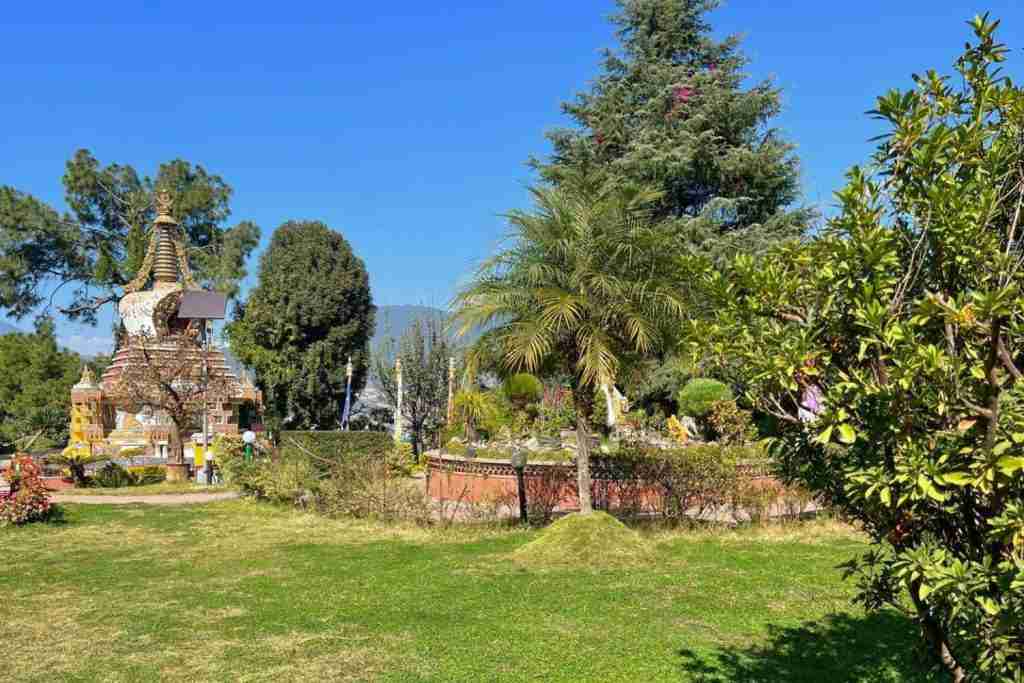
The staff was very attentive, caring, and really look forward to everyone being there. Kopan is an active monastery, it’s not like you’re off in some isolated retreat in the woods, it’s a fully operational monastery, with the debates going on, pujas, and all of this stuff happening. It’s quite nice to be held in that type of environment. It’s an immersion into monastic life to some degree.
Christopher Harris

The retreat was 30 days, and there was quite a bit involved with it. The monastery is pretty spectacular and the energy was very special. It was interesting because it was very loud; there were monks chanting and doing pujas all the time. And it is at the top of a mountain, under the flight path of the Kathmandu airport, so every five minutes or so there were jets flying overhead, which was interesting and fun.
The course was pretty intensive, which struck me right away. They basically tried to induce mental, spiritual, and physical fatigue; the reason I think they do that is to show you your “I,” and it becomes apparent quickly. When you wake up at 4:30 in the morning to do 30 prostrations, then the schedule goes to 9 p.m. every day, without any days off, it’s intense.
They basically tried to induce mental, spiritual, and physical fatigue.
We started off with meditations, we had Venerable Steve who facilitated the teachings. He’s a brilliant monk, very high level, and he knows Tibetan, so he gave a lot of etymology on the language. That’s the thing about Tibetan, depending on the interpreter there are different words they choose, so the interpretation of the language is very dynamic. Tibetan is very contextual, so it’s interesting to learn all the synonyms and what means one thing in one context means something different in another.
Basically, it was a crash course on the Lam Rim. We had a little workbook, it was pretty short, only 100 pages because the Lam Rim is very thick. They did a really good job of introducing all of the concepts of Buddhism. That was the first time that I had delved into the Lam Rim, it was everything in a nutshell of the teachings we receive from Gen Don and Geshe Sherab at The Buddhist Center; it was just the first time I had seen it all put together, so that was very important for me. A lot of it was things I’d heard before but seeing it all threaded together in continuity was very interesting.
Basically, it was a crash course on the Lam Rim.
After the meditations, we had minor breaks and then we would start in on the teachings with Venerable Steve and then we would break for lunch. Lunch was always eaten in silence. They did silence from the beginning of lunch through the next day’s lunch sometimes. So every other day it was silent and that was kind of an interesting thing to experience with so many people there, maybe high 200s in attendance. It started out close to 300 people, only about 20 people left. There have been some classes where 50 or 100 people leave.
Most people in attendance were not Buddhists, so that was an interesting experience. After teachings we’d have these lunch discussion groups, kind of mock debates. One of the things that Tibetans really believe in is debating what you’re learning—it’s about hearing, contemplating, meditating, but also discussing what you’re learning with your peers in a debate format.
One of the things that Tibetans really believe in is debating what you’re learning.
We would take topics from what we learned and apply them in a conversation with each other and we had people from all over the world, all different backgrounds, religions, and perspectives; one of the highlights for me was those discussions with people. Once you try to put into words what you’re learning it takes on a whole other perspective in your mind. That was the point of debate, to really seal the learning in a deeper way.
After the discussion groups, we had more meditation, then group talks after the evening meditation, we even did movie night a couple of times. Then they’d have other people come in and speak, different monks nuns and lay people. It was a very intensive and wonderful experience, I highly recommend it.
It was a very intensive and wonderful experience, I highly recommend it.
What advice would you give to someone before going?
It was hard to get in, it’s first come first serve, so you log into their website at a specific time on the day they open registration. If you wait past the time you may not get a slot. There are a lot of people that go from all over the world, there were like 300 seats and it filled up within a few hours. It was like going to a Taylor Swift concert, from what I hear.
The other thing is you can’t have your phone, I was tied to my phone and email, so that was a struggle. People should be aware of that. To prepare, you can start digging into the Lam Rim, if you’re a practicing Buddhist you’ll be doing that anyway. But they’ll give you everything you need when you’re there. And be ready to see your “I,” it’s not always pretty.
I highly recommend this course to anyone who is interested, not just in Buddhism, but in looking inward.

Interviews conducted by Isabela Acebal
0 Comments