
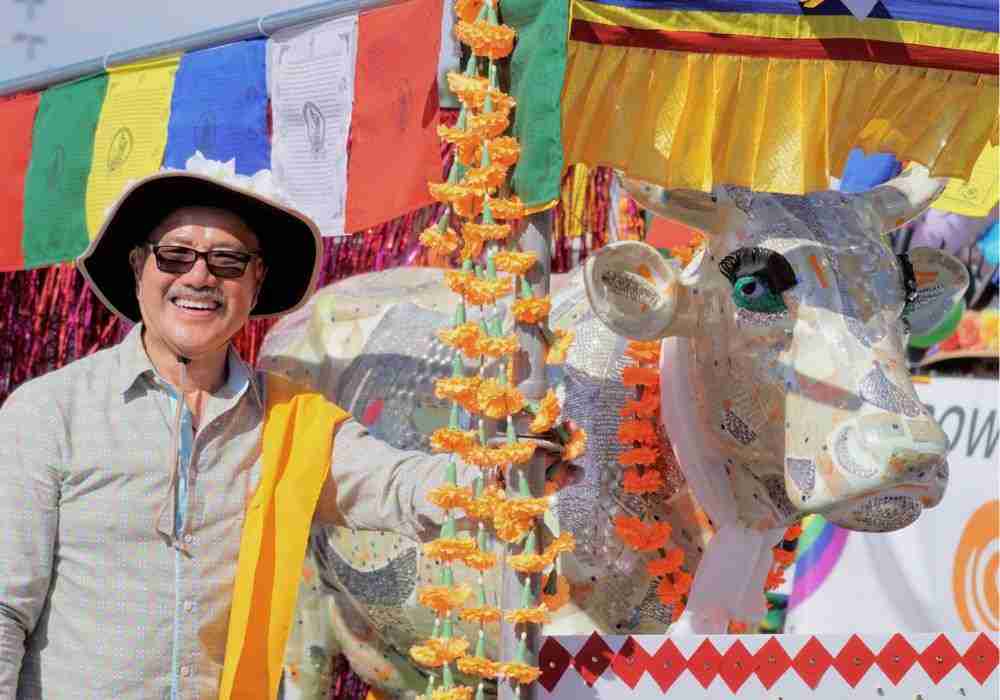
It all started in the year 2000 when New York requested to have a New York Cow Parade. It was a type of tourist attraction, an exhibition of 300 cows all over the city. There were also some very big-time artists that requested to do the cow. It was up for public view for about three months in the summer, so the weather was good and people could walk around the city and see all of the cows.
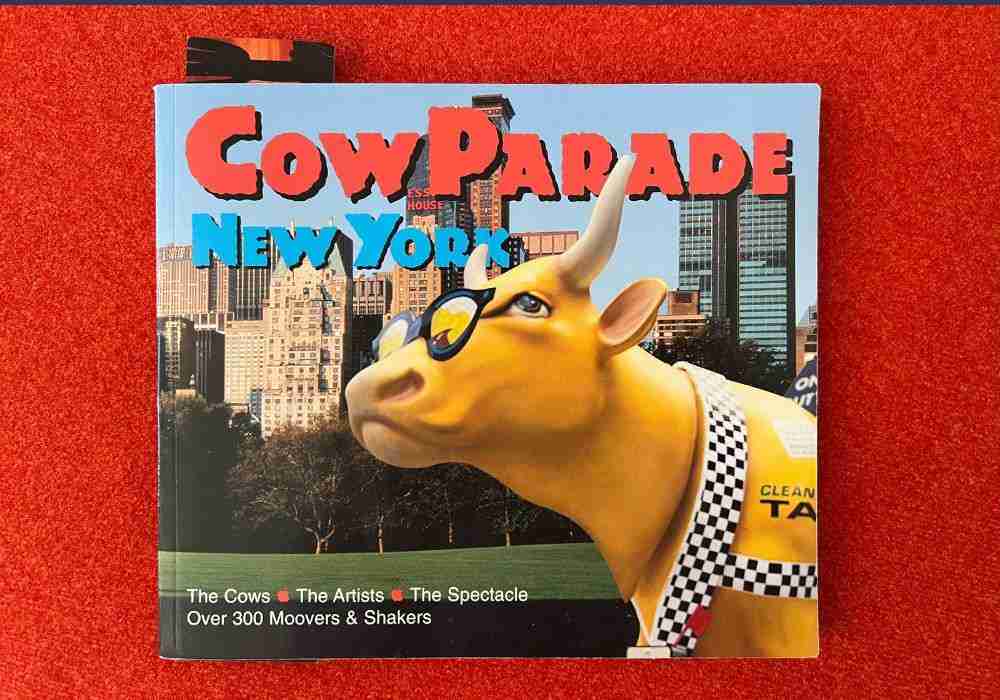
The Making of the Cow
At that time I was a school teacher and they had allocated a few cows for public schools. Some you could work with students on and some you could propose a design as an artist. I was teaching elementary so I didn’t know how safe it was with kids, so I proposed it as an individual design.
They accepted my design in the summer of 2000, and they asked me to pick out a spot where I wanted to show the cow, in relationship to my design. I picked down Water St.—near Wall Street—because I was impressed by the skyscrapers. I was living in Staten Island, so I’d take the ferry to work, and I’d see this gorgeous, shiny building on Water St.
My design was going to be completely covered with Mylar, to look like a building. Mylar is a very shiny film, like a mirror, it’s a flexible, shiny material with a sticky back. Unfortunately, they ran late in delivering the cows to the artists, so I only had two weeks to finish the work.
When I got the cow I had a studio in Chinatown. The cow came completely white; it was made of fiberglass with a metal frame inside, it was very sturdy, like a car. All I had to do was work on it, but I was working full-time, so I could only work at night and on weekends. I had to change the design and put the Mylar on like cow spots. The rest was going to be painted in green, orange, and blue, because those are the colors of New York State.
I named it New York State of Cow. The green was because of the Statue of Liberty, Patina green, but even simplifying it I was making it complicated for myself, because in between each Mylar I was putting each color, and it took a lot of time.
Finally, I finished all the patterns, the rest I freely painted like a canvas, a very loose brushstroke. Then that was done and I looked at the eyes—they were white—so I painted the eyes, put on eyelashes with rubbers, crushed some emerald green, and filled the outside of the pupil.
After the Cow Parade
That was all done in 2000. The deal was the organization was going to give me $4,000 in exchange for designing the cow, and they were going to auction off the cow. Well, there were more cows than they could sell, so they said, Sorry, we can’t give you the money like we promised. Instead, you can donate it to the organization or take the cow back, so I chose to have the cow back.
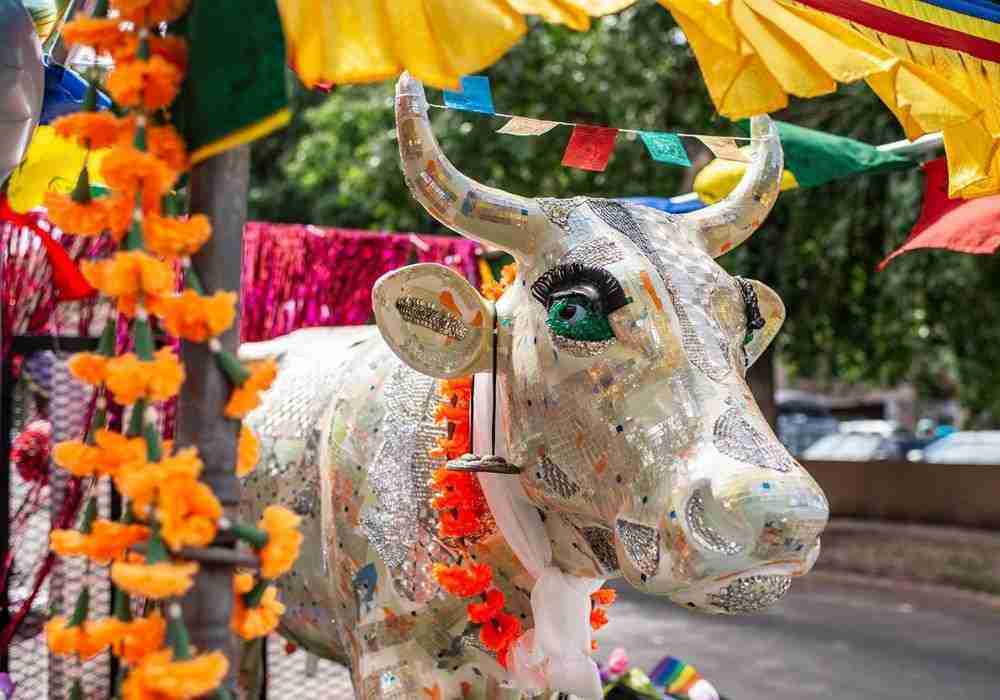
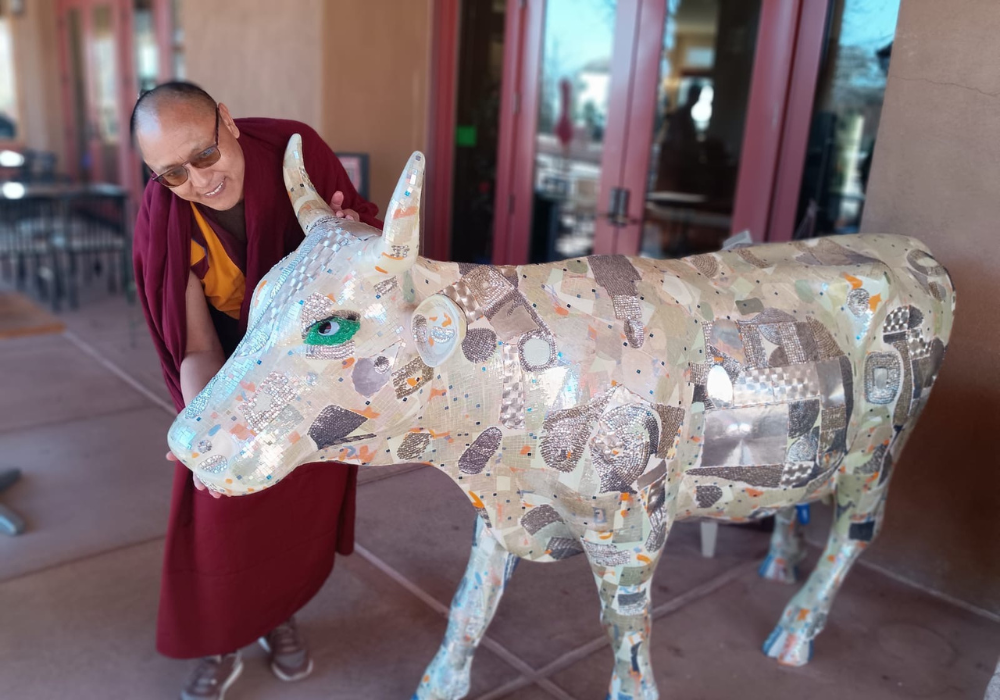
The cow had been outside 24/7, people had been peeling off the Mylar, tourists and kids had ridden the cow, so when I got it it was dirty and smelly because people disrespected it. So I had to wash the cow down, and because it was damaged, I decided to redesign it. I had sequins, so I started fooling around and covering the Mylar that was missing, and I ended up putting a lot of sequins.
It was one by one, and the sequins were so small that it took me 14 years to cover the whole thing. From 2000 to 2009 I was in New York and I would paint and work on the cow then I left New York City to retire from being an art teacher, and move to Santa Fe. The cow was in the back of my delivery truck and came all the way from NY to Santa Fe. I had a painting studio in Santa Fe and I kept working on it from 2010-2014 until a gallery decided to show my work.
I took it to a body shop, coated it three times with polyurethane, and the gallery was very optimistic that someone would buy it and raised the price to $11,000. I was willing to just get $4,000, which was what I originally had in mind. But it was good publicity for the cow. And when nobody bought it, it came back to my studio but I decided I couldn’t keep it in my studio anymore. Some people suggested leaving it in my yard or on the roof of my house, but I wanted to preserve it a little bit.
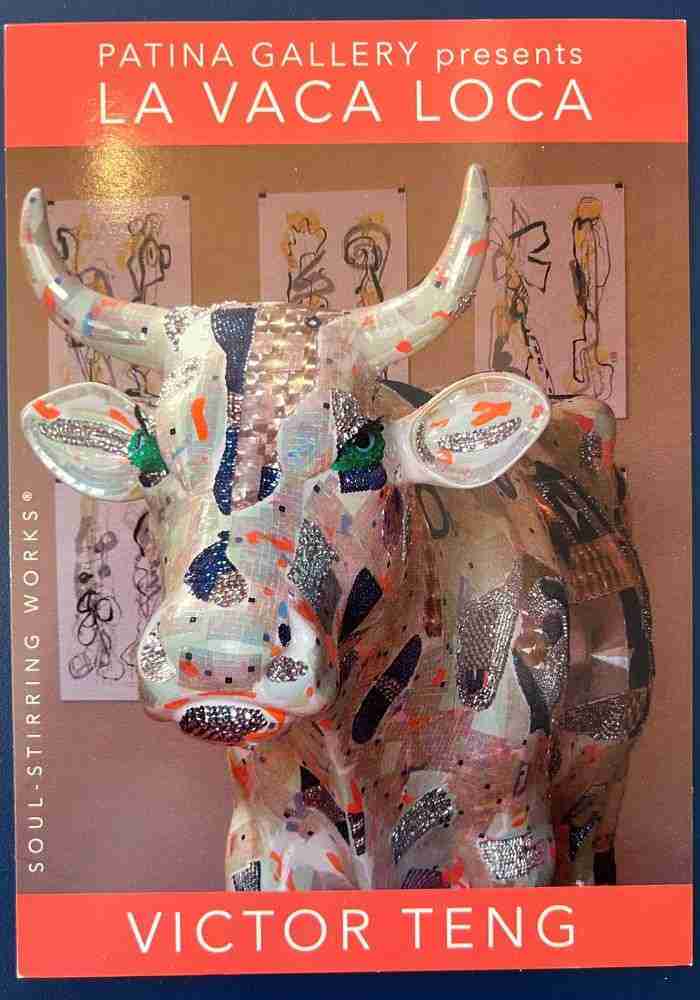
In 2018—I knew the owner of a restaurant near Museum Hill, it’s a cafe between the Folk Art Museum and the Indian Museum, so I asked if I could temporarily leave the cow on the premises so they could use it as a prop to entice people to come in and buy food. He said, Of course. I said, If I sell it you can get some of the commission, but from 2018 to now, it was never sold, it was just sitting in the restaurant.
In 2019, I started coming to The Buddhist Center and I started practicing Tibetan Buddhism, and I remember reading a passage about a wish-granting cow and a wish-fulfilling tree. Before Nina, Charmaine was our director, and this new center was already under construction, so I asked if she would be interested if I donated the cow to be part of the center. She said, Yes, we would love that, but give me the dimensions, and I’ll talk to the Feng shui people.
The only thing I requested was that it was under a covering. It could be in the open air, and it will disintegrate eventually—that’s part of impermanence—but I don’t want to reconstruct it again because I already did it once. She said a wish-fulfilling cow would be a great thing to be part of The Buddhist Center. Later, Nina and Jeff saw it in the restaurant and Nina said she’d love to have it in the center. I said, You don’t have to pay me anything, as long as I don’t have to reconstruct it. So, this year, 2024, the cow will be delivered to the center.
When I moved to Santa Fe, I changed the name to La Vaca Loca, which means The Crazy Cow in Spanish. I don’t know, maybe in The Buddhist Center it will be called the Wish-Fulfilling Cow, which is much nicer than The Crazy Cow.
Since 2000, so many other cities had the Cow Parade, in Florida they did flamingos, in Santa Fe they had horses, in Canada they had moose. The cow is very exotic, has lots of glitter, has a bit of New York, a bit of New Mexico. The cow is 95 inches long, 29 inches wide, and 57 inches high. It is about 125 pounds, hollow, with a metal frame. It was originally on a cement base that weighed about 400 pounds, but the organization kept the cement base.
This is my one and only big sculpture, and it was a long process, but I love the cow. I think it has a lot of character and the cow is such a sacred animal in India so it’s very appropriate for me to donate it to The Buddhist Center. I spent many years on it and it is part of me, but I am happy to share it with the community, with The Buddhist Center. Hopefully, it will entice people to come, witness the cow, touch the cow, and ask for wishes.
It really all started with the phrase “a wish-fulfilling tree and a wish-granting cow.”
Victor’s Background as an Artist
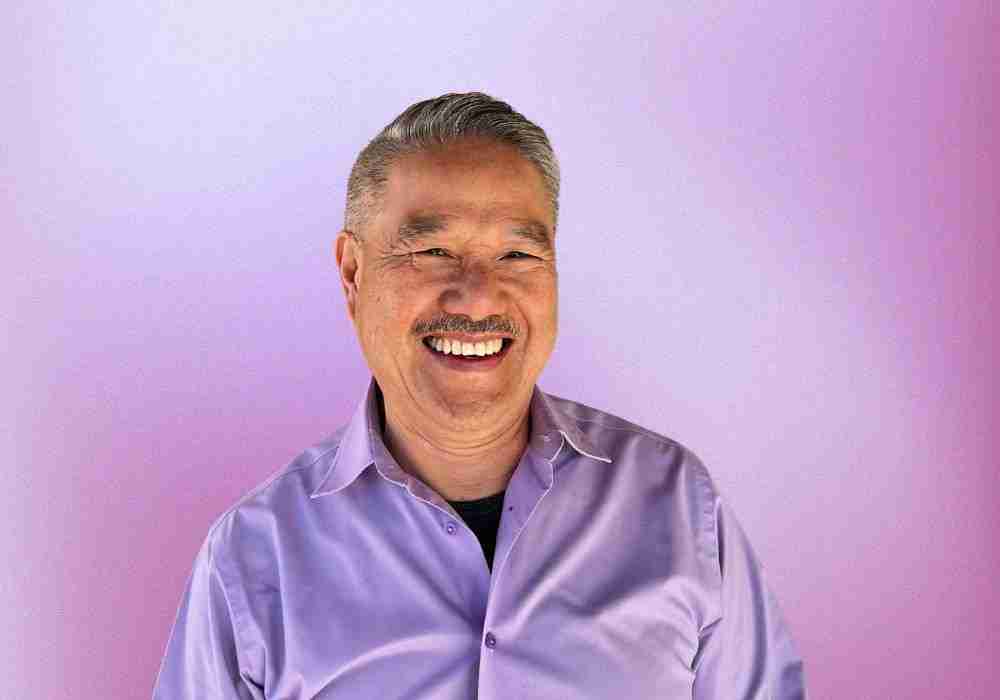
My parents wanted me to be in the medical field, and I was studying medical technology for a little bit. But I had a very influential art teacher who thought I had real potential to be a good artist; he said, Why don’t you try it? The moment I took my first art class, I felt very much at home with myself. Even when I was young I always thought I could be an artist, I was always interested in visual things.
As a kid, my first artwork—and I remember my parents took a picture of it—was a dragon made out of pieces of rice, my mom thought it was very good. In a way they supported me, because they said, Do what you like. I excelled in it, my teacher really pushed me, and I got my bachelor’s degree at the University of Oklahoma in painting and ceramics.
Ceramics was very interesting for me, but as a young artist, it was very hard to be a potter because there were very limited resources in the big cities. You need kilns, and permission to have gas and fire. As a painter it’s much easier, you rent a painting studio with four walls, even with no walls, and you could create your art. I decided to major in painting and minor in ceramics.
Once I left Oklahoma, I decided to go to graduate school, I wanted to go to California, but I wasn’t accepted. However, I was accepted to colleges in New York City. My first art experience was at The Brooklyn Museum Art School—which doesn’t exist anymore because they ran out of funds—but it was the Max Beckman Scholarship Program, and I was accepted and was a resident artist for six months.
It was a practicing studio, it wasn’t academic, so you had a studio, and you just created your art. You had fellow artists from all over the country who came, visiting artists, and it was very practical. It was all about painting and having shows.
With all of those credits and classes, I was able to apply to Hunter College to get my MFA, Master in Fine Arts. I was one of the first to get the MFA in Studio Art and not Art History, and it was great. I met a lot of New York artists, a lot of the artists I visited through our program were mostly feminist artists, like Judy Chicago, before she moved to New Mexico.
Two main art movements that were very prominent in the city were the feminist artists and also the pattern painters. There was a movement where artists were taking patterns as their main influence in their work, you could look at textiles, you could look at buildings, but it had to have a basic pattern. At that time, my teacher was doing pattern painting with feminist content because his great-grandmother was part of the suffragettes in New Orleans.
I graduated from Hunter with an MFA in painting and a job fell in my lap, which was working in the fashion industry, I was just doing clerical work, but it was a good job with great benefits, and I could travel a lot.
But because I was so behind in my artwork, I decided to take a sabbatical and go back to painting. So I quit and while I was painting, New York had a resurgence to bring back money to the public schools, so they needed artists who wanted to teach. I didn’t have an education background, I was a fine artist. But a school in Brooklyn needed an art teacher, so they hired me on the spot.
I was going to school at night, getting my educational credits, and as I was teaching I was getting my license certified. By the time I finished the first three years, I was certified to teach art from kindergarten to high school, and I did teach all that range. My last three years were teaching in high school in the Bronx, and then I decided it was time for me to go back to painting. I retired at 55 with some benefits and moved to Santa Fe because of that, and I was able to survive doing my art.
Now, I’ve been in Santa Fe for the last 15 years. I discovered pottery again, I still paint in the summer but in the fall and spring I take classes at the community college. It’s interesting because I didn’t do pottery for 30 or 40 years and someone told me the community college had a great ceramics department. As soon as I took my first class, I got back to throwing on the wheel, it’s like riding a bicycle, you don’t forget it. I started throwing pots and of course, I was kind of rusty, but the basics were there.
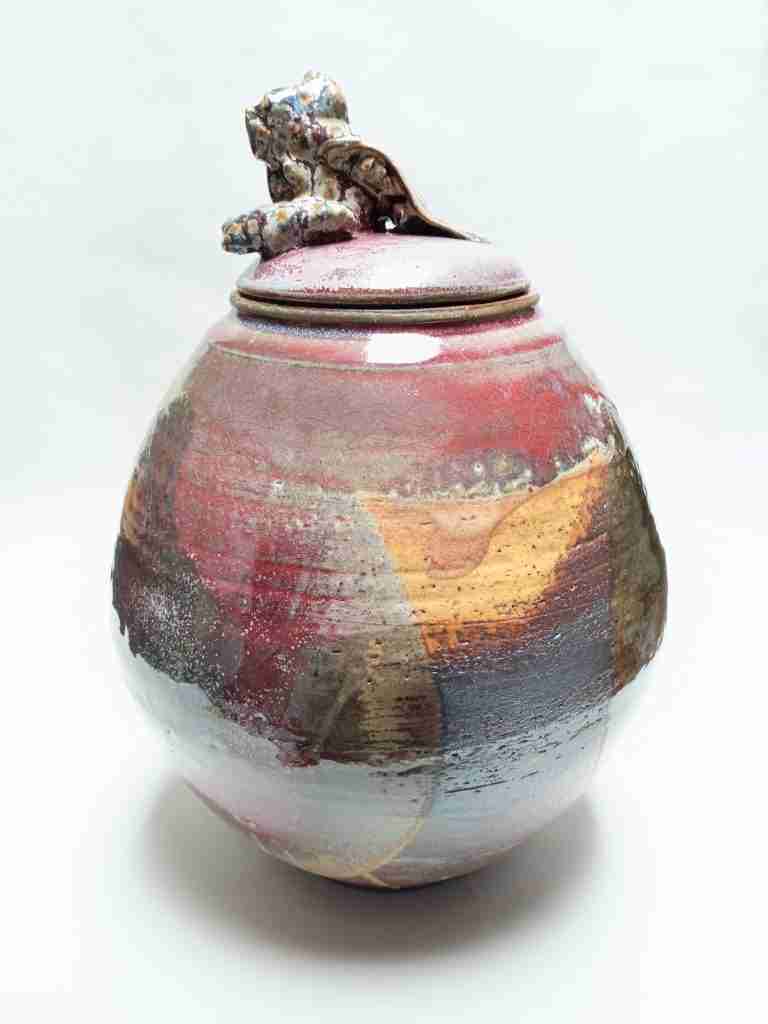
Now I’m doing both functional and sculptural pieces. I love painting so I’m trying to incorporate Buddhism into my painting and pottery. Not very literal, more of a suggestion, subconsciously it always comes out.
Did it feel like a meditative process creating the cow?
I decided to use sequins, and they had to be glued with tacky glue one by one. It was like painting, I would just sit there and create all of these patterns of sequins, and I would do it one by one. Since it was just glue, I had to protect it, so I went to the car body shop and did 3 coats of polyurethane.
Besides being a meditative thing, the sequins were like giving it a skin, making the cow quite reflective. The whole purpose was to get people to pay attention to the cow, from the eyes to lashes to the colors to the sequins to the Mylar, it was all meant to attract people who walked past the cow. I’m also honoring the cow, it is my one and only cow, and I really wanted it to showcase that kind of work.
The sequins also led me to use sequins in my paintings. I wasn’t covering my whole painting with the sequins, but I would paint or draw using the sequins. I usually used see-through sequins, like the scales of fish, but it creates a beautiful iridescent surface to the work. I’m using that now in my painting.
They are usually small, because they are meant to be sewn on, but I just glue them right next to each other. As I said, even with the polyurethane it will start to peel off because they are just glued on with regular tacky glue, but hopefully, the covering and polyurethane will make it last.
Now with painting, I’ve been doing a lot of brushwork, Chinese calligraphy, and brush design, I am primarily an abstract painter. I also wanted to incorporate old Tibetan prayer flags into my works on paper. I asked Geshe Sherab if I could do that, and he said, Yes, they’ve been blessed, but you can’t cut them. So with my latest work of calligraphy, I placed old prayer flags around the painting, and instead of gluing I sewed it into the piece of paper, using string to attach the flag. They are just attached on the top so they can still wave. That’s what I mean when I say I integrate Buddhist materials and iconography into my work.
Interview conducted by Isabela Acebal
Thank you TNL, Nina, Isa, Jeff, Charmaine, and Matt for giving me the opportunity to share “The Wish-Fulfilling Cow” publicly at The Buddhist Center. Thank you also for the lovely Blog/ Interview done by Isa with Nina’s support. I am so gratefully happy that the cow has finally found her home and purpose at The Buddhist Center.
With sincere gratitude and dedication.
Beautiful story about how the cow came about and your journey. Now it is here at TNL giving all visitors a greeting of pure blessings from your heart!
Thank you, Jeff, for your kind words about the cow’s story! You really captured the spirit of what we hoped to achieve – creating a warm, welcoming presence that shares blessings with everyone who visits TNL. It means so much to hear how it resonates with visitors like yourself.
The wish-fulling cow eventually found it right home. Thank you. It’s an impressive piece of art.
The wish-fulling cow, from what I read, belongs to Hindu mythology.
Victor Teng is a great artist. Glad you enjoye his interview
Really enjoyable read. What a journey! What a cow!!
Glad you enjoyed Victor Teng Interview about designing and making Cows
It was an interesting story. Glad you enjoyed it.